
How to create volume galleries
The Volume Galleries add-on allows you to quickly build many galleries at once from images organized in a folder structure. You can choose a source gallery to act as the guide to apply settings for each of the galleries generated. An optional data CSV file will allow you to further customize each gallery that is generated.
Image Sources
Volume Galleries supports two ways to provide images for bulk gallery creation: FTP upload and Cloud Storage import.
FTP Upload
- In your FTP program, find the root folder for your WordPress installation. Look for the “wp-config.php” file – that is your root WordPress folder.
- Then navigate to “wp-content/uploads/sunshine/upload”
- Create a new folder on your server. Name the folder anything you want, but it is recommended to not use any special characters.
- Upload your images or folders of images in the new folder you just created. The file or folder name will be used to generate the name of the gallery by default.
If you organize your folders in a hierarchical structure, the generated galleries will follow that same organization.
Cloud Storage Import
If you have the Cloud Storage add-on installed and connected to a provider, you can import images straight from your bucket instead of uploading them to your server first. This is ideal if your images already live in cloud storage, or if FTP uploads to your web host are slow or unreliable for the volumes you're working with.
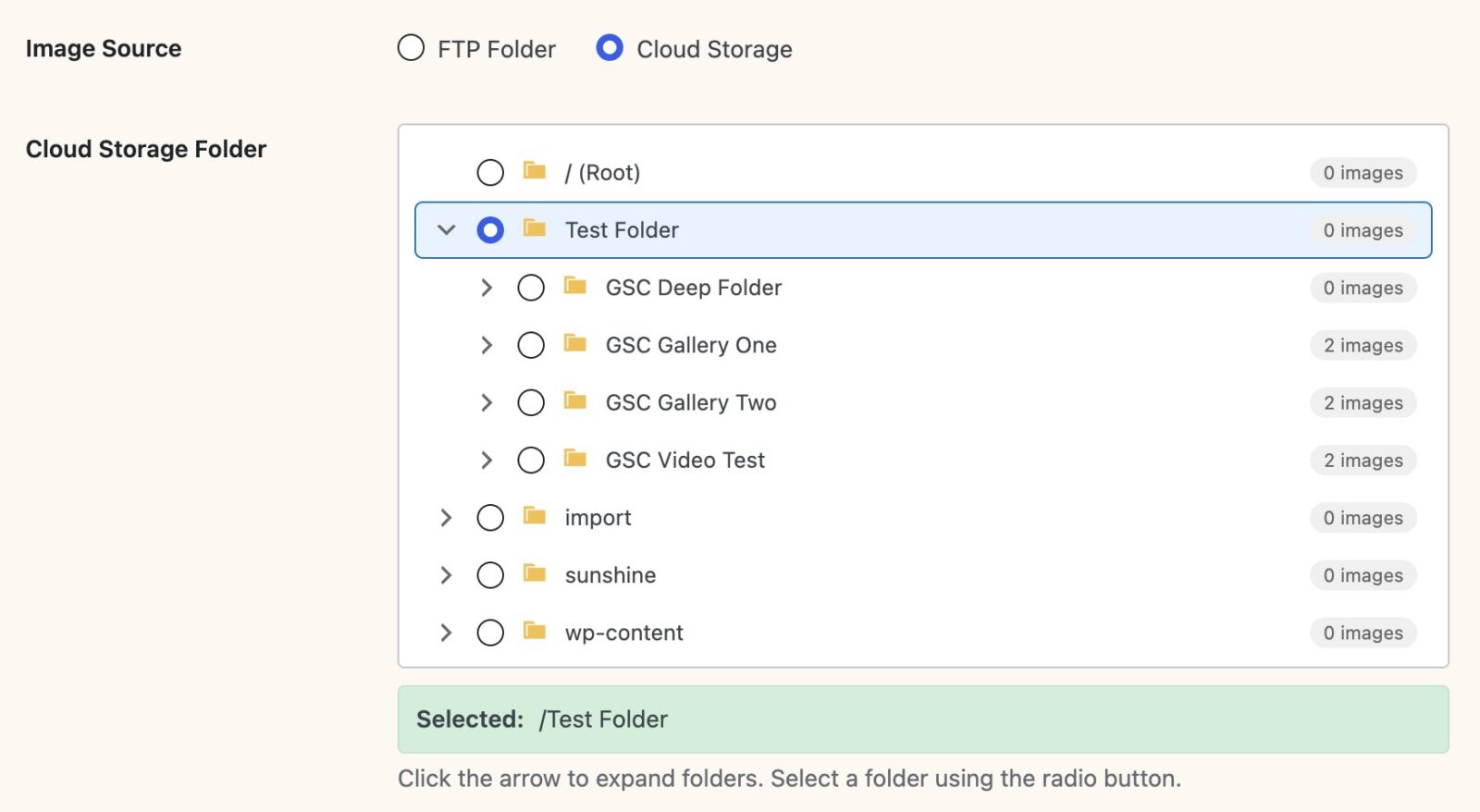
How to pick a cloud folder
On the bulk gallery creation screen, you'll see an Image Source option with two choices: FTP Folder and Cloud Storage. Switch it to Cloud Storage and a folder tree loads from your connected bucket. Click folders to expand them and see what's inside, then click the one you want to import from. The selected path shows just above the tree so you can confirm your choice before continuing.
You only see this option when Cloud Storage is fully set up. If you haven't connected a provider yet, start with the Cloud Storage setup guide.
Folder structure
The folder rules are the same as FTP. Each folder in your bucket becomes a gallery. Subfolders become child galleries under their parent. A folder with just images and no subfolders creates a single gallery containing those images. The scan goes up to 10 folder levels deep, which is more than enough for the usual photographer workflows.
What happens to your files
By default, Sunshine downloads each image from the bucket, processes it (resizing, watermarking if you have that enabled, generating thumbnails), and then the Cloud Storage add-on uploads the processed versions back to your bucket at the standard sunshine/{gallery-id}/ path. Your original source folder stays untouched — nothing is deleted, moved, or renamed. You can safely keep those originals as a backup or delete them yourself after the galleries are created.
If you want to skip the download-and-reprocess step entirely, see the Pre-processed Images section below.
Hierarchical Folder Structure
If you organize your FTP folders in a hierarchical structure, the generated galleries will follow that same organization. This means:
- Each folder you create becomes a gallery
- Sub-folders within folders become sub-galleries (child galleries) under their parent folder's gallery
- The parent-child relationship of your folders is automatically preserved in the gallery structure
Important: the folder you select as your image source acts as a container. It is not itself turned into a gallery; everything inside it becomes galleries. That is why the example below wraps everything in an outer my-event folder that you select.
For example, if you upload this structure and select the my-event folder as your image source:
wp-content/uploads/sunshine/upload/
└── my-event/                         (select this folder — it stays a container, no gallery)
    └── wedding-photos/
        ├── ceremony/
        │   ├── image1.jpg
        │   └── image2.jpg
        ├── reception/
        │   ├── image3.jpg
        │   └── image4.jpg
        └── portraits/
            ├── couple/
            │   └── image5.jpg
            └── family/
                └── image6.jpg
Learn how to add this custom code to your WordPress website
This will create the following gallery hierarchy:
- Wedding Photos (parent gallery)
- Ceremony (sub-gallery with 2 images)
- Reception (sub-gallery with 2 images)
- Portraits (sub-gallery)
- Couple (sub-gallery of Portraits with 1 image)
- Family (sub-gallery of Portraits with 1 image)
The plugin automatically detects the folder hierarchy and sets up the parent-child relationships between galleries during the creation process. Each folder inside the one you select will become a gallery, and galleries created from sub-folders will automatically be assigned as children of the gallery created from their parent folder.
Generate Galleries
Once your images are in place — either uploaded to the server via FTP or organized in your cloud storage bucket — you can begin creating the galleries.
Go to Sunshine > Bulk Add New
- Select a source gallery which the settings for the generated galleries will be copied. You can use published, private, or draft galleries as the source.
- Optionally select a parent gallery for the generated galleries to be assigned under. Private and draft galleries can also be selected as the parent.
- Choose your image source. If you uploaded via FTP, pick the folder you created. If you have Cloud Storage connected, switch to Cloud Storage and pick a folder from the bucket tree.*
- Optionally upload a CSV data file which will be used to customize the galleries you are creating. Download a sample CSV file. Learn more about the CSV data file and how it can be used.
- Click the "Review galleries to be created" button to be taken to a screen explaining everything that will be generated.
- If all looks good, continue and generate all the galleries.
* If you select a folder with just images and no sub-folders, a gallery for each image will be generated
If an Import Is Interrupted
Large imports take a while, and sometimes one stops before it finishes. A connection drops, a request times out, or the server hits a file it cannot copy.
When that happens you get a Retry button. Clicking it continues from where the import stopped rather than starting again from the beginning, so nothing already imported is done twice and the progress bars carry on from where they were.
The Retry button appears whether the import was cut off by a connection or timeout problem, or stopped because the server reported something it could not do, such as a file it was unable to copy.
If an import keeps stopping at the same point, that usually means one particular file is the problem. Turning on Enable logging in Sunshine > Settings > General records which file it was working on, which tells you which one to look at.
Pre-processed Images
For very large imports, you can skip server-side image processing by providing pre-generated thumbnails alongside your original images. This dramatically speeds up the import process since the server doesn't need to resize each image.
To use this mode, select Pre-processed as the import mode on the bulk gallery creation screen. Your images should follow this naming convention:
image.jpg                  (original)
image-thumbnail.jpg        (pre-generated thumbnail)
image-large.jpg            (pre-generated large version)
Learn how to add this custom code to your WordPress website
Each original image should have matching -thumbnail and -large versions in the same folder. Filenames are case-sensitive and must match the pattern exactly. During import, the plugin uses these pre-generated files instead of creating them, which saves significant processing time when working with thousands of images.
Pre-processed mode pairs especially well with Cloud Storage as your source. If you've already generated the thumbnail and large variants in your bucket, Sunshine can reference them directly in the cloud without downloading, processing, and re-uploading. That turns a multi-hour import into something much faster for large sets.
Video Support
If you have the Video Sales add-on installed, Volume Galleries can import video files alongside your photos. During import, the plugin automatically extracts a thumbnail from each video and links the video file to the gallery image. Supported video formats follow the same formats accepted by the Video Sales add-on.
Place video files in the same folders as your images. The import process handles them alongside photos without any extra configuration.
How to use the data CSV file
Each row in the CSV file customizes one of the galleries being created. Columns are read by their position, not by the name in the header row, so the order of the columns has to stay the same. The header row is just there to help you keep track of what goes where.
The columns, in order:
- Source: This must match an image file or folder name inside the folder you picked. For a folder, use the plain folder name (
dogs). For a single-image gallery, use the full file name including the extension (family-2.jpg). Capital letters don't matter, but extra spaces do, so don't pad the value. - Gallery Name: By default, the name of the gallery comes from the file or folder name. This lets you set a custom name instead.
- Password: If the Source Gallery chosen in the first step of this process is password protected, all subsequent galleries will also be password protected with each one getting an automatically generated unique password. This lets you specifically define the password to be used.
- Email, First Name, Last Name: The person who should get access to this gallery. If you are creating user accounts, this is the address the account is made with. It is also the address used to notify the customer about their gallery if you checked that option on the first step.
Adding more than one person to a gallery
You can give several people access to the same gallery. Add another Email, First Name, Last Name set of columns for each extra person, up to five people per gallery.
Everyone listed in a row is treated the same way. Each one gets their own customer account (if you checked the option to create users), each one gets private access to that gallery, and each one gets the notification email.
Keep all three columns for every set, even when you leave the name fields blank, so the columns after them still line up.
Example
This is the sample file you can download below:

Reading those three rows:
- family-2.jpg is a single image, so it becomes its own gallery. Only the name is changed. No password, nobody assigned.
- dogs is a folder. It gets a custom name, a set password, and one person on it.
- lee-01.jpg is another single image, with two people on it. Both John and Chris get access and both get notified.
Empty cells are fine. Leave them blank and the default is used.
Still need help?
If you have not yet found your answer in the documentation articles, please contact support